


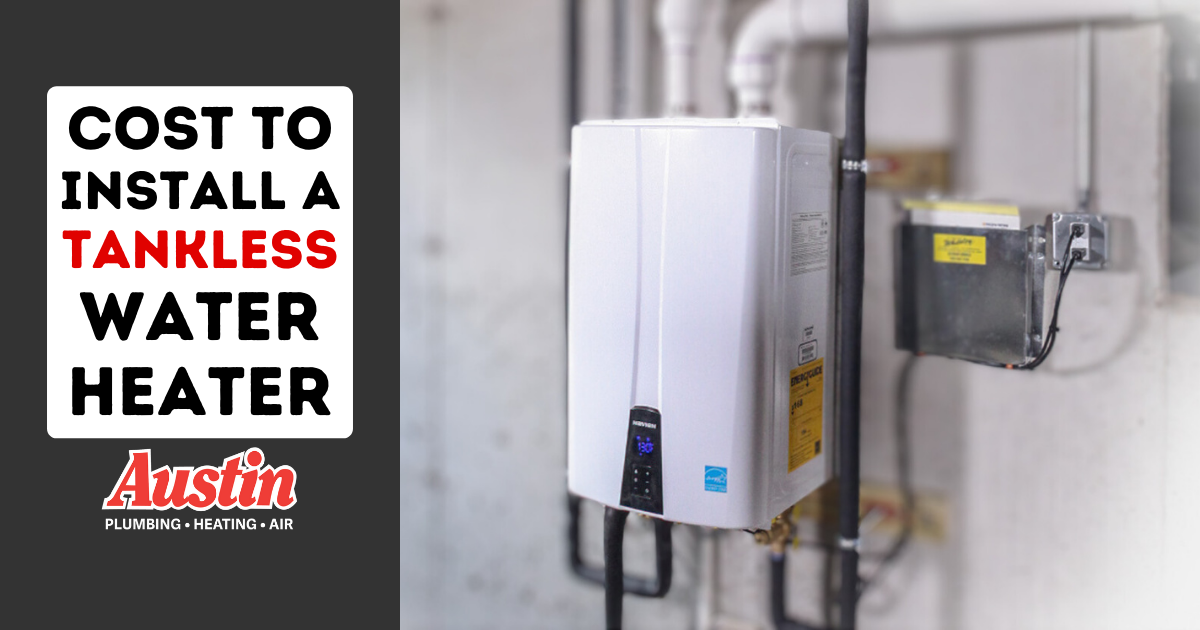
Tankless Water Heater Installation Cost: What Wisconsin Homeowners Should Expect in 2026
A tankless water heater project in Southeastern Wisconsin can reasonably cost about $4,000 to $9,000.
That is a big range because two very different jobs are usually being lumped together under the same search:
Replacing a tankless water heater that is already installed.
And converting a conventional tank-style water heater to tankless for the first time.
Those are not the same project.
A straightforward existing tankless replacement can begin in the $4,000s. Many replacements land roughly in the $5,000 to $7,000 range depending on what existing gas, venting, electrical, condensate and water-piping infrastructure can responsibly be reused.
If you are converting a tank-style water heater to tankless, roughly $7,000 to $9,000 is a more realistic planning range for many complete conversions in Southeastern Wisconsin.
Those are planning expectations, not a quote for a home we have not seen.
The actual price depends on the equipment and the work required around it.
THE SHORT ANSWER
How Much Does a Tankless Water Heater Cost Installed?
|
Tankless Project |
Useful Planning Expectation |
|
Straightforward existing tankless replacement |
Can begin in the $4,000s |
|
Many existing tankless replacements |
Roughly $5,000–$7,000 |
|
Tank-style water heater to tankless conversion |
Commonly roughly $7,000–$9,000 |
|
More involved conversion |
Can approach or exceed $9,000 |
The most important question is not:
“What does a tankless water heater cost?”
It is:
“What kind of tankless project do I actually have?”
That is what determines whether the number belongs toward the lower or upper end.
REPLACING AN EXISTING TANKLESS WATER HEATER
Existing Tankless Replacement Is Usually the Simpler Job
If your home already has a properly installed tankless water heater, a lot of the expensive supporting infrastructure may already exist.
That can include:
- Gas piping
- Venting and combustion-air piping
- Electrical power
- Condensate drainage
- Hot and cold water piping
- Service valves
- Wall penetrations
- Mounting location
- Recirculation components
That does not mean all of it can automatically be reused.
The replacement equipment still has to be compatible with what is there.
But when much of the existing installation remains usable, replacing tankless with tankless is usually a much smaller project than building the system for the first time.
That is why existing tankless replacement can begin in the $4,000s, with many projects moving into roughly the $5,000 to $7,000 range depending on the unit and what else has to change.
CONVERTING FROM A TANK TO TANKLESS
A Tank-to-Tankless Conversion Is a Different Project
A conventional tank water heater and a high-output gas tankless water heater do not necessarily need the same things from the house.
A complete conversion may involve:
- New or modified gas piping
- Verification that the gas system can support the new load
- New exhaust venting
- New combustion-air piping
- Electrical power or a dedicated circuit
- Condensate drainage
- A condensate pump where gravity drainage is not practical
- New hot and cold water piping
- Tankless service valves
- Recirculation equipment
- A different mounting location
- Removal and disposal of the old tank
- Abandonment or correction of old venting
- Permit and inspection
- Startup and commissioning
- Other code or compatibility corrections
That is why many complete tank-to-tankless conversions land around $7,000 to $9,000.
You are not just buying the appliance.
You are adapting the house so the appliance can operate properly.
WHY SOME CONVERSIONS APPROACH $9,000
A standard atmospheric-vent tank water heater can be a relatively simple appliance.
A modern gas tankless water heater can be close to 200,000 BTUs and depends on several systems working correctly at the same time.
A conversion may require us to build a new vent and combustion-air path through the house.
The existing gas piping may not have enough capacity.
The heater needs electrical power.
Condensate has to go somewhere.
Water piping has to be adapted.
Service valves need to be installed so the equipment can be maintained later.
The old heater has to come out.
The installation has to be permitted, started up and tested.
None of that is exotic.
It is simply the work required to turn a home that was built around a tank water heater into one that properly supports tankless equipment.
POWER-VENT TO TANKLESS
Some Conversions Start With More of the Infrastructure Already in Place
A power-vent tank water heater can sometimes make a tankless conversion easier than an older atmospheric-vent tank.
The home may already have:
- Electrical power at the water heater
- A sidewall vent route
- PVC venting in the area
- A location that works well for modern equipment
That can reduce the amount of supporting work required.
Our current pricebook reflects that difference.
A power-vent-to-tankless conversion is currently priced materially below our more involved standard-vent-to-tankless conversion because the scopes are different.
That is the point homeowners should take from those numbers.
The existing water heater and the house around it matter.
WHY INTERNET TANKLESS PRICES ARE ALL OVER THE PLACE
Search tankless installation cost online and you will find numbers that seem to have almost nothing in common.
Often, they are not pricing the same thing.
One number may represent:
- The tankless unit sitting in a box
Another may represent:
- Labor to replace an existing tankless heater
Another:
- A straightforward installation where gas, venting and electrical already work
And another:
- A complete first-time tank-to-tankless conversion
Geography changes labor and permit costs too.
Equipment changes.
Scope changes.
The house changes.
Internet pricing can help you understand the general size of the investment.
It cannot tell you what it will take to convert your particular house.
A PHONE PRICE IS MOSTLY A PRICE ON ASSUMPTIONS
Tankless is one of the hardest water-heater projects to price responsibly without seeing the installation.
Before we can build a real conversion scope, we need to know things such as:
- What water heater is there now?
- Where is it installed?
- Can the existing gas system support the new heater?
- How far would new gas piping have to run?
- Where can the exhaust terminate?
- Where will combustion air come from?
- How long is the vent route?
- Where will condensate drain?
- Is electrical power available?
- Does the installation require a dedicated circuit?
- How are the hot and cold lines routed?
- Does the home need recirculation?
- What happens to the old vent?
- What does the municipality require?
If a contractor has not looked at the gas supply, vent route, electrical, condensate, water piping and installation location, they are not really pricing your conversion.
They are pricing an assumption.
Our preference is simpler:
See the installation. Build the scope. Then price the actual job.
NOT EVERY COMPANY THAT INSTALLS TANKLESS IS SELLING THE SAME JOB
A company that gives a tankless conversion price over the phone may operate very differently from a company that inspects the house before building the proposal.
Both may technically install tankless water heaters.
That does not automatically make the two offers comparable.
The meaningful comparison starts with the approach.
Does the contractor determine gas capacity?
Do they inspect the vent route?
Do they account for electrical?
Condensate?
Recirculation?
Permitting?
Commissioning?
Future serviceability?
Written scope?
Then compare the actual work.
Then compare the price.
Before you compare the numbers, make sure you are comparing the same kind of company and the same kind of job.
DON’T ASK ONLY “IS THAT INCLUDED?”
Ask: “Where Is That Written?”
Tankless installation has enough moving parts that verbal assurances are not a good way to compare proposals.
Ask where the important work is shown in writing.
For example:
- What tankless model is included?
- What size/output is included?
- Is the gas work included?
- Is new venting included?
- Is combustion-air piping included?
- Is the electrical work included?
- Is condensate drainage included?
- Are service valves included?
- Is water-piping modification included?
- Is recirculation included?
- Is removal of the old water heater included?
- Is the permit included?
- Is startup and commissioning included?
- What existing components are being reused?
- What work is specifically excluded?
- What warranty applies?
A contractor saying “yes” after you ask about something is not the same as that work being included in the proposal before you asked.
A good estimate should tell you what you are buying.
Our proposals are intentionally detailed for that reason.
Don’t compare what two contractors say they’ll do. Compare what they put in writing.
WHAT CHANGES THE COST OF A TANKLESS WATER HEATER INSTALLATION?
1. Replacement or First-Time Conversion
This is usually the biggest distinction.
Existing tankless replacement may reuse substantial infrastructure.
A conversion may require creating it.
2. Gas Supply
Tankless water heaters can require substantially more gas input than the tank heater they replace.
The existing gas piping has to be evaluated for the appliance and the other gas equipment in the home.
Sometimes the existing gas setup works.
Sometimes it needs modification.
That changes the project.
3. Venting
Vent length, termination location, pipe size, fittings, combustion-air requirements and manufacturer limits all matter.
A short usable existing route is very different from building a new vent path across a basement and through an exterior wall.
4. Electrical
Gas tankless water heaters still require electricity.
Depending on the existing installation and equipment, electrical work may be straightforward or require a new dedicated circuit.
Austin has plumbing and electrical capability under one roof, which makes that coordination easier when the project crosses both trades.
5. Condensate
High-efficiency tankless equipment produces condensate.
That water has to be discharged correctly.
A nearby floor drain may make this simple.
Another installation may need more drainage work or a condensate pump.
6. Water Piping
The new heater may not connect exactly where the tank did.
Piping changes, valves and service connections all become part of the installation.
7. Recirculation
Tankless does not automatically mean instant hot water.
The hot water still has to travel through the piping between the heater and the faucet.
Some homes benefit from recirculation.
How that recirculation is accomplished can change both the installed price and the homeowner experience.
8. The Existing House
Retrofit work is exactly that: new equipment being connected to an existing house.
The age, condition, layout and prior modifications to the home’s mechanical systems can all affect what the new installation requires.
DOES THE TANKLESS WATER HEATER ITSELF COST $7,000 TO $9,000?
No.
When we talk about a $7,000 to $9,000 tankless conversion, we are talking about the installed project.
The tankless heater is part of that number.
So are the materials and labor required to convert the home around it.
A complete project can include:
- The heater
- Installation materials
- Water piping
- Service valves
- Gas work
- Venting
- Electrical
- Condensate
- Removal
- Permit
- Startup
- Commissioning
- Other required retrofit work
That distinction is important when comparing an online equipment price with an installed proposal.
They are not the same product.
IS TANKLESS CHEAPER THAN A REGULAR WATER HEATER?
Usually not upfront.
If the only objective is to restore hot water for the lowest reasonable initial investment, replacing a tank-style water heater with another tank-style heater will usually cost less than converting the home to tankless.
Tankless becomes interesting for different reasons.
A homeowner may value:
- Long-duration hot water
- More available floor space
- Avoiding a large stored volume of hot water
- A particular hot-water demand pattern
- Recirculation capabilities
- The long-term characteristics of tankless ownership
There is no reason every failed tank water heater needs to become tankless.
There is also no reason to dismiss tankless simply because the first installation costs more.
It depends on what you want from the system.
For conventional replacement pricing, see:
Water Heater Replacement Cost
For conventional replacement service:
Water Heater Replacement & Installation
YOUR FIRST TANKLESS INSTALLATION AND YOUR NEXT ONE MAY COST VERY DIFFERENT AMOUNTS
There is another ownership detail that is easy to miss.
The first time a home converts to tankless, a lot of the project can be about building the infrastructure the appliance needs.
Gas.
Venting.
Electrical.
Condensate.
Service valves.
Water piping.
Mounting.
Once those things are properly in place, the next tankless replacement may be a much simpler project.
That means:
First-time tankless conversion cost and future tankless replacement cost
are not necessarily the same ownership event.
The first installation may involve adapting the house.
The next one may primarily involve replacing the equipment.
WHAT SHOULD A COMPLETE TANKLESS QUOTE INCLUDE?
Before choosing a contractor, make sure you understand the complete scope.
A useful proposal should identify, where applicable:
- Manufacturer and model
- Equipment output and sizing
- Old-water-heater removal
- Water piping
- Tankless service valves
- Gas piping
- Venting
- Combustion air
- Electrical work
- Condensate drainage
- Recirculation
- Permit
- Startup and commissioning
- Existing items being reused
- Work specifically excluded
- Warranty terms
- Final installed price
If two quotes have substantially different numbers, compare these things before concluding one contractor is simply more expensive.
“YOU GET WHAT YOU PAY FOR” ONLY MEANS SOMETHING AFTER THE JOBS ARE EQUAL
The most expensive tankless proposal is not automatically the best one.
The least expensive proposal is not automatically the smartest one either.
Large price differences usually have an explanation.
Sometimes the equipment is different.
Sometimes the scope is different.
Sometimes installation standards are different.
Sometimes one company has included work the other has excluded.
Sometimes one price is based on assumptions the other contractor already investigated.
And sometimes the jobs really are comparable and one company simply costs less.
That is why the useful sequence is:
Get the jobs equal first.
Get the companies reasonably equal.
Then compare price.
INSTALLATION MATTERS MORE WITH TANKLESS THAN MANY HOMEOWNERS REALIZE
A lot of plumbers can physically connect water, gas and venting to a tankless water heater.
That does not automatically mean the appliance was installed the way the manufacturer intended or that the installer understands how the equipment operates.
Tankless systems depend on:
- Correct gas supply
- Correct venting
- Combustion air
- Water flow
- Electrical power
- Sensors
- Controls
- Condensate
- Manufacturer setup requirements
The heater only works as well as the installation around it.
That is also why future serviceability matters.
A good installation should make maintenance and diagnosis easier later.
Service valves matter.
Access matters.
Piping layout matters.
Electrical access matters.
Austin brings plumbing, electrical and heating/combustion capability together when the project crosses trades.
Our plumbers are also trained to use testing instruments and manufacturer procedures when diagnosing tankless equipment later.
What we learn servicing these systems influences how we install them.
ASK YOUR INSTALLER WHAT HAPPENS AFTER INSTALLATION DAY
Tankless installation is only the beginning of the equipment’s life in your home.
Before choosing a contractor, ask:
Can you maintain the tankless equipment you install?
Can you diagnose it when it throws an error code?
Do your technicians know how to test gas pressure, voltage, water conditions and the other inputs the heater depends on?
Who handles manufacturer warranty problems later?
That matters.
If the tankless heater has a problem several years after installation, you should not have to start from zero with a contractor who has never seen the system.
The company putting the heater on the wall should be thinking about the day somebody has to service it.
WHAT IF MY TANKLESS WATER HEATER IS STILL UNDER WARRANTY?
If another contractor installed your tankless water heater and it is still under the manufacturer’s parts warranty, our first recommendation is normally:
Call the original installing contractor.
They know what they installed, should have the equipment information and are usually in the best position to work through the manufacturer warranty process.
If that contractor will not help, contact the manufacturer and ask:
“Who is your authorized warranty service representative in my area?”
Then call that company.
Austin can help when needed.
But if you already have warranty coverage and an installer or authorized warranty representative who can use it, that may be the better first call.
That is also something worth considering before choosing who installs a new tankless heater.
TANKLESS WATER HEATERS STILL NEED MAINTENANCE
Tankless does not mean maintenance-free.
Minerals can accumulate inside the heat exchanger.
Inlet screens collect debris.
Serviceable components need attention.
Water quality matters.
Manufacturer maintenance requirements matter.
Regular flushing or descaling can be an important part of tankless ownership, especially in homes with harder water.
We see another side of this during repair calls:
A number of problems that look like tankless failures turn out to involve maintenance conditions.
If you want equipment you never have to think about again, tankless is not that.
Neither is a tank.
For tankless repair and maintenance information:
FINANCING A TANKLESS WATER HEATER
Financing is available for qualifying Austin tankless replacement and installation projects.
Approval, rates and terms are determined by the third-party lender.
If spreading the project cost over time makes more sense than paying for the complete conversion at once, we can show you the available financing options when we build the proposal.
FINAL BUDGET SUMMARY
If you are replacing an existing tankless water heater and much of the infrastructure can responsibly be reused, the project can begin in the $4,000s, with many replacements landing roughly in the $5,000 to $7,000 range depending on the equipment and what has to change.
If you are converting a tank-style water heater to tankless, roughly $7,000 to $9,000 is a more realistic planning range for many complete conversions in Southeastern Wisconsin.
Some projects will fall below those expectations.
More involved projects can move above them.
The important part is knowing what the number represents.
See the installation. Define the scope. Put it in writing. Then compare the price.
Thinking About Tankless? We’ll Show You What It Actually Takes.
You do not need to determine the gas size, vent route, electrical requirements, equipment output or recirculation strategy before calling us.
We will look at the system and the home.
We will determine what a proper tankless installation would require.
We will show you the scope and the price.
If tankless water heater makes sense, we can handle the project.
If another tank water heater makes more sense for your priorities and budget, we will tell you that too.
Talk to Austin About Tankless
262-367-3808


